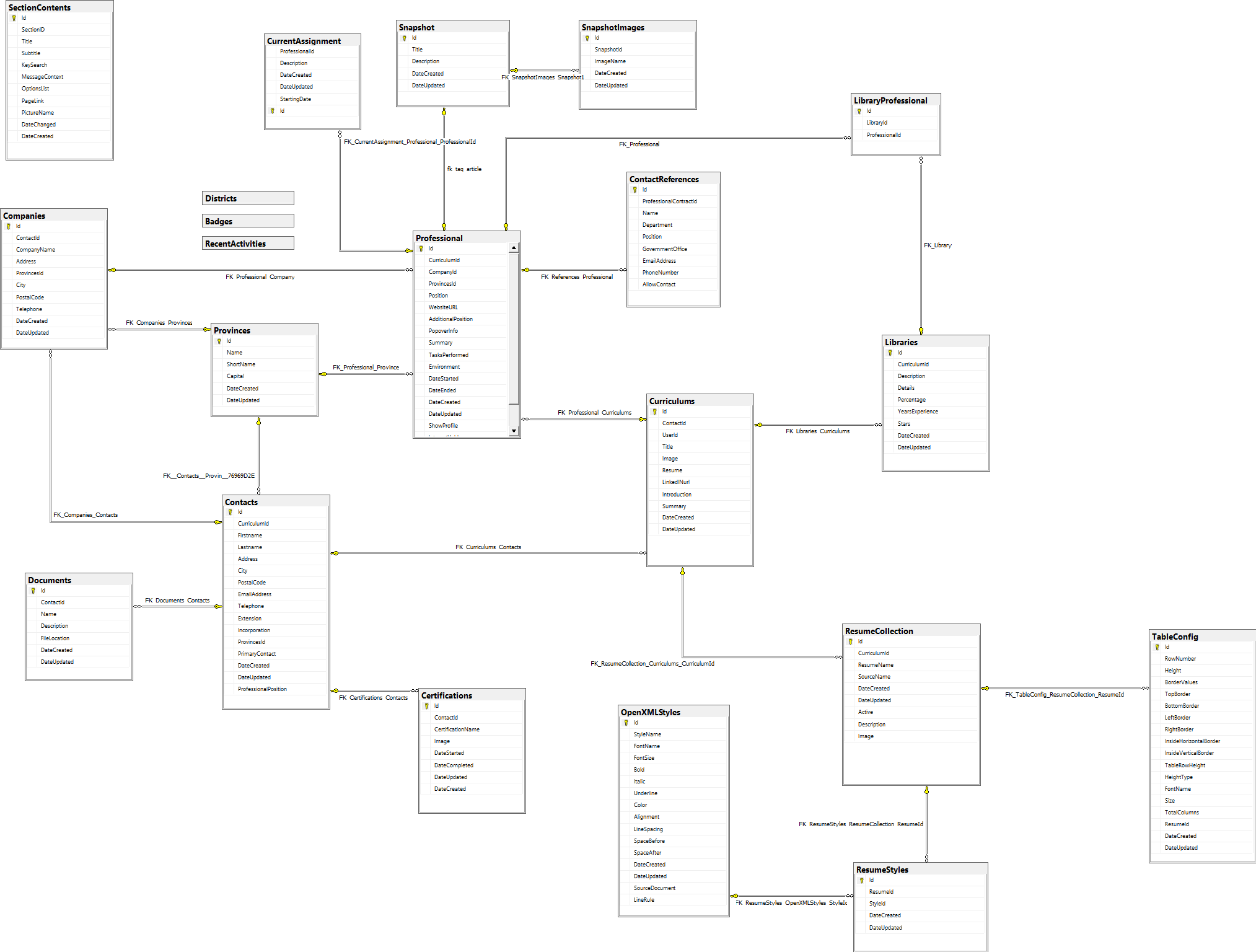
The Web-Resume was developed in ASP.Net MVC and ASP.Net Razor pages and in both cases the application using different tiers.
Multiple tiers typically refer to the separation of concerns into different layers: Presentation Layer, Business Logic Layer (BLL), and Data Access Layer (DAL). This architecture helps in organizing code, making it more maintainable and scalable.
- Presentation Layer: This is where your views and controllers reside. It handles the user interface and user interactions, including Cascading Style Sheets (CSS) and JavaScript. Modal forms provide a user-friendly way to interact with the application without navigating away from the current page.
- Business Logic Layer (BLL): This layer contains the business logic of your application. It processes data received from the Presentation Layer and interacts with the Data Access Layer. This is where Contracts and implementations are defined.
- Data Access Layer (DAL): This layer is responsible for interacting with the database. It performs CRUD operations (Create, Read, Update, Delete). In this tier we have all the models definitions and relationships.
SQL Server database, using Repository Pattern. From Book "Patterns of Enterprise Application Architecture" by Martin Fowler. The repository pattern is a design pattern used to abstract the data access layer from the business logic layer in an application. In ASP.NET, it helps manage data access logic in a more organized and maintainable way.